

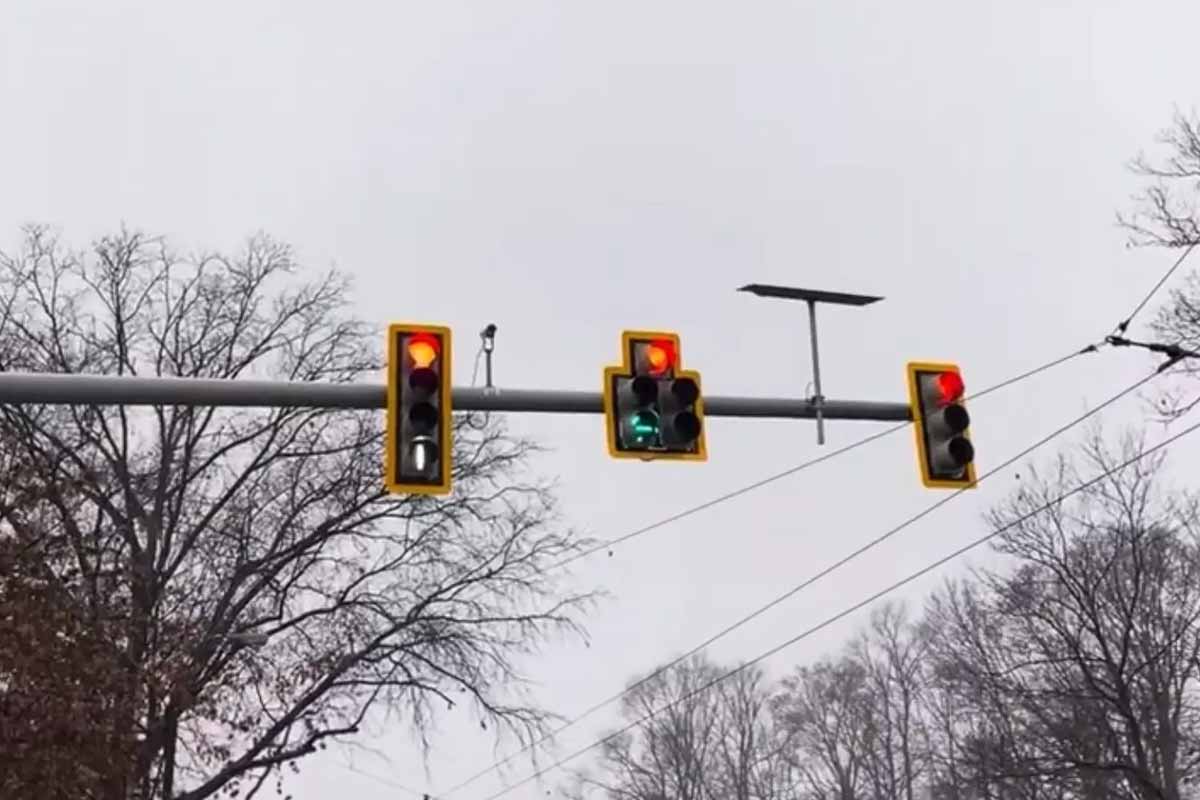
A familiar intersection may soon feel different, while the rhythm stays calm. In the United States, researchers want to add a fourth signal color. The idea targets a specific type of car, without changing the basics for everyone else. Cars would share data and set pace together. People would follow smoothly. Used well, traffic lights could reduce hesitation and wasted time in daily commutes. The extra color appears only in certain moments. Standard signals stay in charge.
Understanding the white signal and what it changes
Red means stop, yellow signals caution, and green allows movement through the junction. The proposal keeps that familiar code. It adds a white lamp above or below the trio. Drivers still stop, slow, or go as usual in most cycles. One extra cue appears only when conditions justify it.
The white lamp stays off most of the time. It turns on only when enough automated vehicles reach the intersection together. Those vehicles coordinate approach and timing through wireless links. The signal recognizes the mix and grants the group control. Human drivers then avoid guesswork and mirror the flow ahead.
Once automated vehicles stop being the majority, the white lamp switches off. The classic cycle returns without drama. Mixed streets will last for years, so that fallback matters. Clear limits reduce confusion during busy peaks. As a result, traffic lights still feel familiar for everyday drivers on city streets.
How traffic lights could hand control to a connected group
The concept relies on distributed computing. Cars and the signal share decisions, rather than waiting for a central brain. Automated vehicles exchange speed, position, and intended paths in real time. The controller checks the mix at the stop line and selects the safest phase. That reduces slow, late reactions.
- Automated vehicles arrive together and form a short-lived pack.
- They share live data with each other and the signal.
- The controller confirms enough smart cars are present nearby.
- The white phase turns on, and the pack sets pace.
- Human drivers hold their lane and match that pace.
As the pack moves on, the system returns to normal. Humans still obey red, yellow, and green. Coordinated vehicles smooth gaps and reduce hesitation. Drivers avoid overtaking, because it breaks the rhythm. Traffic lights then hand control to the network, and take it back, without confusing anyone.
What human drivers do when white shows up
A white phase asks people to drive with less improvisation. The safest move is steady following, with a sensible gap. Sudden lane changes break coordination, so predictability matters more than speed. Drivers often feel less stress, because flow stays even. The goal is fewer split-second choices at the line.
Pedestrians and cyclists still shape the intersection. Researchers also study how it handles crossings, not only vehicles. Signals for people must remain clear, and right-of-way rules stay strict. A smart car still yields when the law demands it. Gains mean little if vulnerable users feel unsafe.
Education decides whether drivers trust the new cue quickly. Clear signs, consistent rules, and enforcement reduce confusion. Drivers also learn when white appears, and when it fades. Simple guidance can come from manuals, training, and roadside prompts. Good habits keep traffic lights from becoming a distracting novelty.
What simulations say about traffic lights and congestion
Early results come from simulation, not citywide rollout. In tests, even a small share of automated vehicles helped. With 10% automated vehicles, delays fell by 3% at the intersection. With 30% automated vehicles, delays dropped by 10.7%. Researchers link gains to cleaner spacing and fewer conflict points.
Delay is not just lost minutes. Long queues waste fuel and raise emissions through idling. Stress climbs too, because people brake and accelerate repeatedly. Smoother movement reduces harsh stops and late yellow rushes. That supports steadier travel times along an urban corridor. Less idling can also cut noise.
Benefits scale as adoption rises, because coordination happens more often. Researchers say it can help mixed traffic too. Fewer competing moves reach the stop line from each lane. When conditions fit, traffic lights stay white longer, then revert quickly. The classic cycle remains a fallback if coordination weakens.
Where pilots may happen and what must change first
A white phase cannot appear on every corner overnight. Vehicles and infrastructure need secure links and shared standards. Many intersections would need upgraded controllers and careful cybersecurity. Cities must also set rules for compliance, faults, and accountability. Even then, traffic lights keep their classic colors for most cycles.
Testing would likely start in controlled environments. Ports stand out, because they have heavy vehicle movement and few pedestrians. Routes repeat, operations run constantly, and measuring delay is straightforward. Commercial fleets often adopt automation faster than private drivers. That mix makes ports a practical first lab for the white phase.
Automation already shares roads with humans, so regulation must keep pace. Clear rules would cover driver behavior, liability, and edge cases. Brands that push limits need firm guardrails, including Tesla. Pilot results would guide signs and enforcement. If pilots succeed, the white phase could bridge today’s streets and tomorrow’s mobility.
Why the fourth color matters beyond pure novelty
The white phase sounds futuristic, yet the idea stays practical. Red, yellow, and green still guide daily driving. White appears only when vehicles can coordinate the flow safely. Over time, delays could shrink, along with stress, fuel waste, and emissions. Rollout will take careful trials and clear teaching. Traffic lights may still evolve into a smarter partner for humans and machines on busy streets. Ports may offer the first real-world test, then cities could follow.